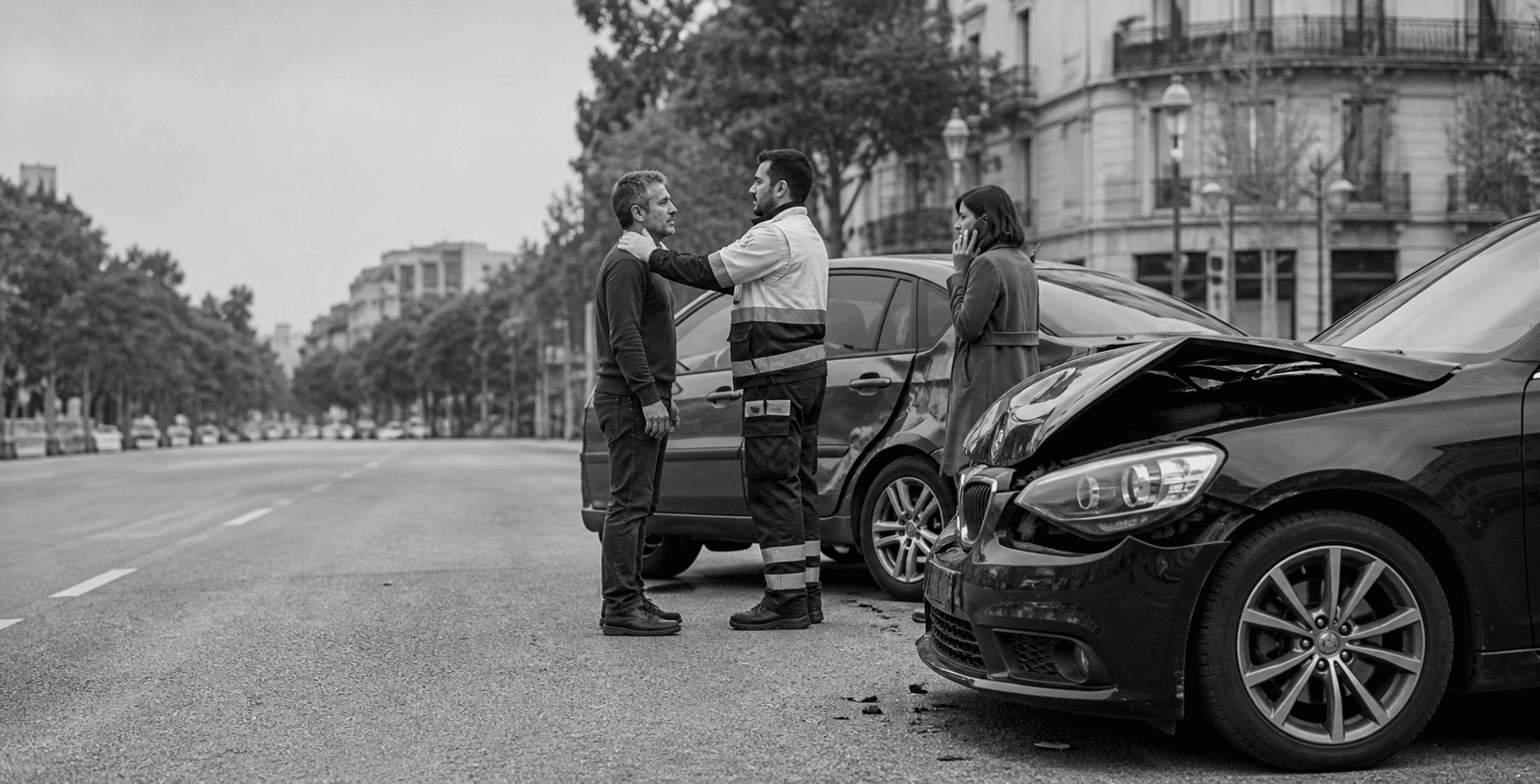
A road traffic accident can result not only in physical injuries but also in expenses, loss of earnings and damage to property. Compensation should seek to cover all of these losses, but identifying and properly documenting each of them is essential.
Below, we explain who may claim compensation, what can be included in a claim and the main steps involved under Spanish law.
Who can claim compensation?
Anyone who suffers personal injury or property damage as a result of a road traffic accident for which another person or entity is wholly or partly responsible may be entitled to compensation. Where a motor vehicle is involved, claims are generally brought directly against the insurer of the vehicle responsible for the accident.
If the injured person was driving another motor vehicle:
An injured driver may claim compensation when the other vehicle is responsible for the accident. If both drivers contributed to the accident, compensation may be reduced according to their respective degree of responsibility.
Passengers will generally be considered injured parties and may claim compensation even if they were travelling in the vehicle whose driver caused the accident.
If the injured person was riding a bicycle:
Where a cyclist is involved in an accident with a motor vehicle, Spanish law provides particular protection due to their status as a non-motorised road user.
In relation to personal injuries, liability is based on the risk created by the use of a motor vehicle. The driver will only be exempt from liability if it can be established that the damage was caused exclusively by the injured person's conduct or by force majeure unrelated to the driving or operation of the vehicle.
If the cyclist also contributed to the outcome —for example, through a proven traffic violation or the improper use of mandatory protective equipment that aggravated the injuries— compensation may be reduced on the basis of contributory negligence, subject to the applicable statutory limits.
Liability should never simply be assumed. Police reports, witness statements, photographs, video footage and, where necessary, accident reconstruction evidence may be decisive.
Furthermore, not every cycling accident involves a motor vehicle. If a cyclist falls because of a pothole, inadequately signposted roadworks, poor road conditions, a defect in the bicycle or the conduct of another cyclist or pedestrian, both the liable party and the claims procedure may be different. Depending on the circumstances, a claim may potentially be brought against the public authority responsible for the road, the organiser of a sporting event, the manufacturer, a repair workshop or the individual responsible for the accident.
What can be included in the compensation?
The Spanish statutory system for assessing damages arising from road traffic accidents —commonly known as the Traffic Accident Compensation Scale (Baremo de Tráfico)— distinguishes three main categories: temporary injuries, permanent injuries and financial losses. Property damage may also be claimed separately.
Compensation is therefore not calculated by simply assigning a single amount to a particular injury. The final figure is determined by adding together all applicable heads of loss that can be properly established in each individual case.
- Temporary injuries: the recovery period
Compensation is payable for the period between the date of the accident and the recovery or stabilisation of the injuries.
Each day is assessed according to the extent to which the injuries interfere with the injured person's ordinary activities. The assessment does not therefore depend solely on whether the person was officially unable to work.
Surgical procedures may also give rise to additional compensation, depending on their nature, complexity and the technique involved.
Important: being on sick leave does not automatically mean that every day will qualify as a moderate level of personal impairment. Similarly, continuing to work does not prevent certain days from being assessed at that level.
The key issue is how the injuries actually affected the injured person's daily life and whether this can be demonstrated through medical records and the person's individual circumstances.
- Permanent injuries
Permanent injuries or sequelae are the physical, psychological, organic, sensory or aesthetic limitations that remain once the recovery process has ended.
The Spanish compensation system assigns points to each recognised permanent injury. Its financial value depends, among other factors, on the total number of points awarded and the injured person's age. The principal categories include:
- Functional impairment: persistent pain, restricted mobility, loss of strength, neurological conditions, psychological disorders and other permanent limitations.
- Aesthetic impairment: scars, asymmetry, deformities and other visible changes. Aesthetic impairment is assessed separately from functional impairment.
- Loss of quality of life: additional compensation may be available where permanent injuries significantly prevent or restrict essential, professional, sporting, family or leisure activities that are particularly relevant to the injured person.
- Additional non-pecuniary losses and future needs: in particularly serious cases, further compensation may be available for technical aids, adaptations to the home or vehicle, future rehabilitation, prostheses or third-party assistance.
Permanent injuries should be assessed once the medical condition has stabilised, and an appropriate medical assessment is particularly important.
For minor spinal injuries —including certain types of whiplash— Spanish law requires a specific assessment of causation. Among other criteria, particular importance is attached to symptoms having appeared, or medical attention having been sought, within 72 hours of the accident.
- Expenses and financial losses
In addition to physical injuries, financial losses resulting from the accident may be claimed where they are causally connected to the accident and can be substantiated.
These may include:
- Medical treatment, rehabilitation, physiotherapy, medication, orthopaedic devices and other medically necessary treatment.
- Travel expenses associated with medical treatment and other reasonable expenses caused by the injuries.
- Third-party assistance, care, adaptations and support products where required.
- Temporary loss of earnings: loss or reduction of income during the recovery period.
- Future loss of earnings: permanent reduction in earning capacity or income where the injuries affect the injured person's employment or professional activity.
- Property damage
Compensation may also be claimed for damage to a car, motorcycle or bicycle, as well as other items damaged in the accident, such as helmets, technical clothing, glasses, mobile phones, child car seats or other personal belongings.
Where possible, damaged items should be kept until they have been inspected or assessed. Photographs should also be taken, and purchase invoices, repair estimates or other evidence establishing their value and age should be retained.
In the case of a bicycle, the claim may cover the cost of repair or, where repair is impossible or uneconomical, the appropriate value taking into account its characteristics and condition before the accident.
Property damage is assessed separately from personal injury.
How do you claim compensation following a road traffic accident in Spain?
A properly prepared claim begins at the time of the accident. Some of the most important steps include:
- Preserve evidence of the accident. Complete an accident statement where possible, request police attendance if anyone has been injured or there is disagreement about what happened, and keep witnesses' contact details, photographs, videos and the exact location of the accident.
- Seek medical attention and report all symptoms. It is important to have medical evidence of the injuries and their progression. In minor spinal injuries, medical attention or documented symptoms within the first 72 hours may be particularly important in establishing causation.
- Follow the prescribed treatment. Keep emergency department reports, diagnostic tests, sick leave documentation, rehabilitation records and any other documents relating to the progression of the injuries.
- Keep evidence of all financial losses. Retain invoices and documents relating to medical expenses, medication, transport, domestic assistance, damaged property and loss of earnings.
- Submit a formal claim to the insurer. The claim should identify the injured parties, explain the circumstances of the accident, identify the vehicles and drivers where known and include the available supporting documentation. It is not necessary to provide a final calculation of the compensation from the outset.
- Carefully review the insurer's offer. Before accepting any amount, check that the injuries have been correctly assessed and that all applicable heads of loss have been included, including recovery days, surgery, permanent injuries, aesthetic impairment, expenses, loss of earnings and property damage.
The insurer's reasoned offer:
Once the insurer receives the injured person's claim, it has three months to make a reasoned offer where liability and the amount of the damage can be established.
If an offer cannot yet be made —for example, because the injured person remains under treatment and their condition has not stabilised— the insurer must provide a reasoned response.
Where recovery is prolonged, Spanish legislation provides for interim payments in respect of losses that can already be established and requires the insurer to keep the injured person informed about the status of the claim.
The reasoned offer must distinguish between personal injury and property damage, identify the documents and reports relied upon and include the final medical expert report where applicable.
Payment of the amount offered cannot be made conditional upon the injured person waiving future claims if they consider that the compensation legally due is higher.
Where the injured person disagrees with the assessment, additional expert medical reports may be requested. Depending on the circumstances, an out-of-court settlement may then be sought or court proceedings may ultimately be commenced.
What is the time limit for making a claim?
As a general rule, a direct claim against the insurer is subject to a one-year limitation period. In personal injury cases, the starting date will depend on the circumstances and is generally linked to the point at which the final extent of the injuries can be established, usually following recovery or medical stabilisation.
Nevertheless, the accident should be reported and the formal claim submitted as soon as reasonably possible. Making the claim interrupts the limitation period and, following formal notification of the insurer's reasoned offer or response, a new one-year period begins.
Do not leave the claim until the last minute. Determining when the limitation period begins and whether it has been interrupted may depend on the medical progression of the injuries and the steps taken in each individual case. A late claim may jeopardise the right to compensation.
What happens if the vehicle is uninsured or leaves the scene?
In certain circumstances, Spain's Consorcio de Compensación de Seguros (Insurance Compensation Consortium) may be responsible for paying compensation, including certain accidents involving unidentified or uninsured vehicles.
Claims for property damage caused by unidentified vehicles are subject to specific requirements. In these circumstances, it is particularly important to report the accident to the police, obtain the relevant police report and preserve all available evidence.
Frequently asked questions:
Is the insurer's first offer final?
No. An offer may be accepted, rejected or challenged.
Before making a decision, it is advisable to check that the medical assessment is correct and that all applicable heads of loss have been included, such as temporary injuries, permanent injuries, aesthetic impairment, expenses, loss of earnings and property damage.
Payment of an offer cannot be made conditional upon a general waiver of the right to subsequently claim any additional amount that may be legally due.
Can I claim compensation if I was not off work?
Yes. Temporary injuries are assessed according to the recovery process and the temporary loss of quality of life. Sick leave is relevant evidence when assessing this impact, but it is not the only criterion.
When should permanent injuries be assessed?
Once the injuries have stabilised and curative treatment has ended.
Settling a claim too early may result in permanent limitations that had not yet become apparent being excluded from the compensation.
Conclusion:
Compensation following a road traffic accident should seek to fully compensate the injured person for the personal and financial losses suffered.
A proper assessment requires an analysis of liability, the recovery period and any permanent injuries, together with the calculation of expenses and loss of earnings and adequate evidence of any property damage.
For this reason, a properly prepared claim involves considerably more than simply entering information into an online compensation calculator. Every head of loss should be supported by medical evidence, financial documentation and the particular circumstances of the accident.
Have you been injured in a road traffic accident in Mallorca?
At Bellver Legal, we handle the entire road traffic accident claims process. We analyse the circumstances of the accident and liability, monitor the progress of your injuries, review the medical assessment, calculate the compensation due and pursue your claim against the insurer, both through out-of-court negotiations and, where necessary, court proceedings.
If you have been involved in a road traffic accident, it is advisable to seek legal advice from the outset. Early legal assistance can help ensure that your claim is properly handled, that relevant evidence is preserved, that applicable time limits are observed and that you avoid decisions that could later affect your right to compensation. You can contact our team from the outset so that we can assess your case and assist you throughout the entire claims process.